


Boat Building
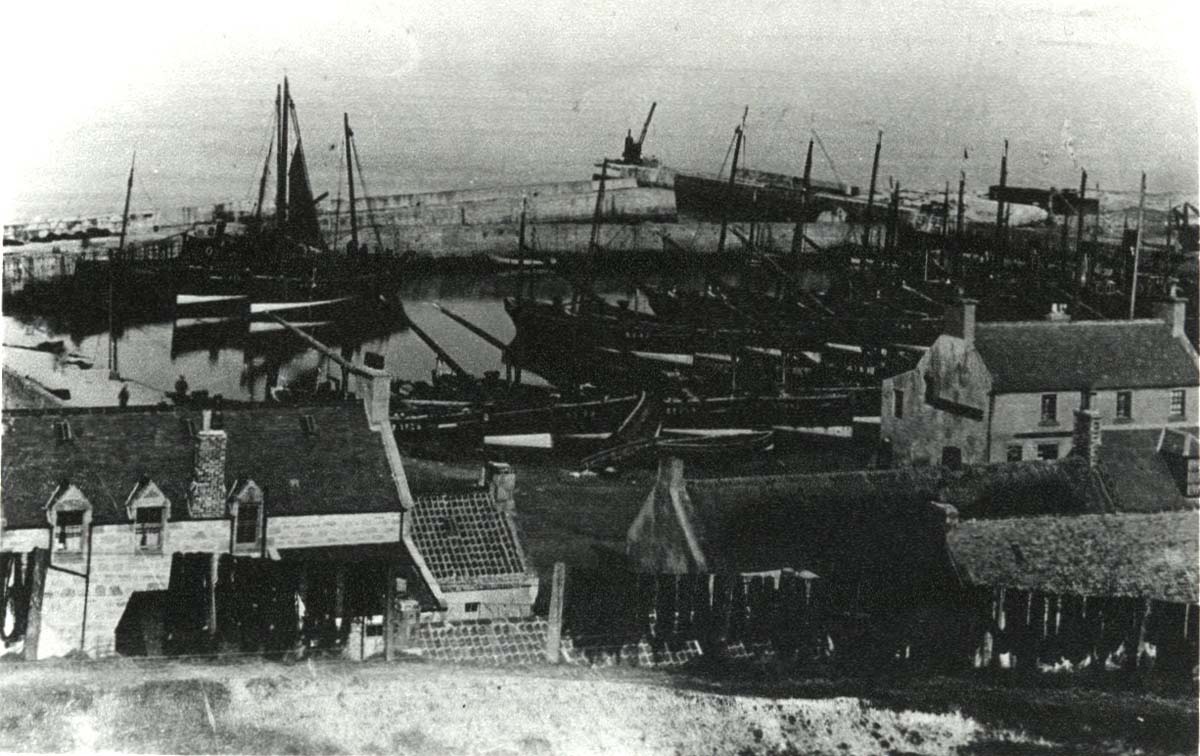
While the debate over the harbour had been raging Port Gordon had developed as a centre for the boat-building industry.
For thirty years, boats had been steadily increasing in size. From the end of the 1870s it had become apparent that boats had to be built which were capable of fishing more distant waters. The first of these boat combined the best of the Scaffie and the Fifie. Legend has it that the new boats were called Zulus after the war raging in South Africa at the time. The first Zulus had keels of around forty feet and cost in the region of £140. The size of crafts continued to increase, as did the size of the sails, which could contain between two-hundred and fifty to three hundred yards of canvas.
The Zulus remained popular until the first years of the twentieth century, with the last such boat being constructed in 1906. Initially, it was John Grigor, whose yards was located in Port Tannachy, who led this trade in Port Gordon. However, during the first decade of the twentieth century, Port Gordon witnessed an expansion of its boatbuilding trade and it was almost entirely down to one man, William “Beal” Geddes, who was one of the most successful boatbuilders of his time. Initially, his yard, located to the east of the harbour, concentrated on repairing angling boats and building salmon cobbles but in time he moved on to build Zulus. However, it was the advent of the steam drifter which transformed Beal Geddes into one of the most notable builders on the Moray Firth.
The early steam drifters were built in Great Yarmouth or Lowestoft. However, these boats were not really suited to the wear and tear of Scottish harbours which were still packed with Zulus. The hulls of the new drifters were too thin and constantly required repairs. Local boat builders decided to improve the drifters by making them more sturdy and able to withstand the rough conditions of the North-East. Whereas the East Anglican drifters were built complete with engine those built along the Moray Firth had to go to Aberdeen, Dundee or Leith for their engines. These new boats were enthusiastically seized upon by many of the most active boat builders such as Beal Geddes. Indeed, it is possible that the Leader, constructed in 1903 by Geddes, was the first drifter built on the Moray Firth.
Beal Geddes’s prowess a boat builder became much sought after and his yard was kept busy. In 1904, he built the Daffodil and Sunbeam, and in 1905 the Winner, amongst others. By the beginning of 1906, he was employing thirty-six men at the yard and was able to turn out one boat per month. At the close of 1906, Beal Geddes’s yard had launched ten drifters in the preceding twelve months. These included Industry, Lead Me and the Corona as well as the Daisy. The latter boat, the Daisy, was notable for having teak and yellow pine panelling in the cabin. It was because of the sale of the predecessor to the Daisy (also built by Geddes) that his name became well-known in Fife. The first Daisy was sold to fishermen in Anstruther, where the boat was much admired. Consequently, several orders were received from Fife.
The following year, 1907, the number employed at Geddes’s had risen to fifty; the work-book contained orders for eleven new boats. At that point some twenty eight drifters had already been built. The yard managed achieve one launch every month or so. In addition to his local commissions for 1907, which including the Restless Wave, the Pleaides, the Violet, Geddes built a number of drifters for fisherman operating out of Kirkcaldy, Anstruther and associated ports. Two of these were the Morning Star and the Pride o’Fife.
During 1908, Port Gordon saw launch of the Hiedra, Golden Swan, and Craignoon which were again for Kirkcaldy seamen. This was in addition to the Letterfourie, a local commission, and the Agnes Dickson and the Hazel Bank which were built for Aberdeen fishermen. However, the trade in drifters had reached its peak and orders slowly began to decline. By 1915, Beal Geddes had ceased trading as far as drifters were concerned, although he continued to build salmon cobbles. His reputation ensured that shortly afterwards he was appointed as a director of Jones of Buckie.


